
MPO Harness Cables 3 Types

MPO Harness Cables Have 3 Types used in Today’s Data Center around the global.Let’s see 3 different type and application.

MPO MTP Harness Cables Types

MPO Harness Cables Types

1- MPO-LC harness cables

As we know, harness cables are generally used to connect high-density switches with LC serial transceivers installed. The transition harness connects to the pre-installed MPO backbone trunk cable and then furcates to LC connectors entering the switch. This kind of MPO-LC harness cables are usually supplied in short lengths because they are normally only used for “in-rack” connections. Transition harnesses are available for Base-8, 12 and 24 backbones and the LC tails are numbered for clear port identification and traceability.

mpo-lc

in This picture you can see how you can use MPO-LC harness cables

MPO MTP-LC harness cables application

MPO -LC harness cables application

2-MPO Conversion Harness Cables
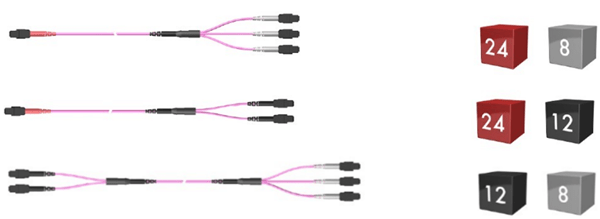
MPO/MTP Conversion Harness Cables

MPO Conversion Harness Cables

Another harness cable type is conversion harness cables, which allow users to convert their existing MPO backbone cables to an MPO type which matches their active equipment. Conversion harnesses are a low-loss alternative to conversion modules because they eliminate one mated MPO pair across the link. Many of today’s legacy infrastructures are built using a Base-12 MPO backbone design, however experience shows us that this connector is rarely used on higher data rate switches or servers. Currently Base-8 is the preferred connector for 40G (SR4) transceivers and Base-24 is the preferred connector for 100G transceivers (SR10).

3-MPO/MTP Trunk Harness Cables
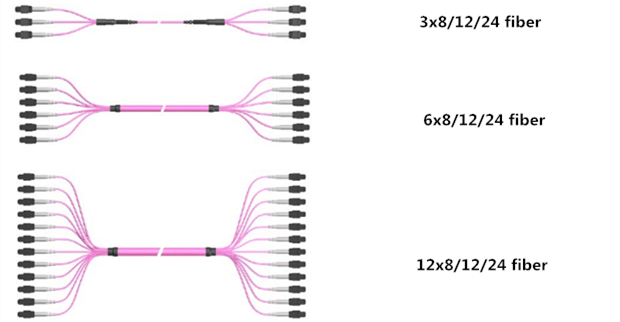
MPO/MTP Trunk Harness Cables

MPO Trunk Harness Cables

The final type of harness cable is MPO trunk harness cables. MPO trunk harness cables are high density multi-stranded cables which form the backbone of the data center. This kind of trunk harness cables are available in different fiber-counts up to 144 fibers, which reduce the installation time by consolidating multiple sub-units into a single cable. This approach significantly reduces the overall diameter of the cable and provides much better space utilization of cable routing channels. Just as two types harness cables mentioned, the MPO trunk harness cables are also available with 8, 12 and 24 fiber sub-units so that users can deploy Base-8, Base-12 or Base-24 infrastructures to suit their MPO connectivity requirements.

Category Overview

MPO/MTP® Harness Cables, often referred to as breakout or fanout cables, are the critical bridge between high-speed optical standards and existing network infrastructure. These assemblies transition from a single multi-fiber connector (MPO or MTP®) on one end to multiple discrete connectors (typically LC or SC) on the other. This design enables the seamless distribution of 40G or 100G signals into individual 10G or 25G channels.

At MeFiber, we engineer these harness assemblies to maximize rack space efficiency while minimizing cable clutter. By utilizing high-precision MT ferrules, our cables ensure low insertion loss and reliable performance in demanding data center environments. Whether you are connecting a high-density switch to a patch panel or directly connecting transceivers, our MPO/MTP® breakout solutions provide the robust physical layer required for modern network architectures.

Key Features

  • Space-Saving Design: Reduces cable bulk by converting high-density MPO trunks into manageable duplex breakouts.
  • Versatile Configurations: Available in 8, 12, or 24 fiber counts, breaking out to LC, SC, or FC connectors.
  • High-Speed Migration: specifically designed for 40GBASE-SR4 to 10GBASE-SR and 100GBASE-SR4 to 25GBASE-SR applications.
  • Premium Components: Utilizes US Conec MTP® or standard MPO connectors for optimal optical alignment.
  • Customizable Jacket: Options include LSZH (Low Smoke Zero Halogen), Plenum (OFNP), and Riser (OFNR).
  • Factory Tested: 100% optically tested for insertion loss and return loss to guarantee signal integrity.

Applications

Harness cables are indispensable in environments requiring bandwidth aggregation and distribution:

  • Data Center Aggregation: Breaking out QSFP+ (40G) ports to four SFP+ (10G) ports on servers or switches.
  • SAN Fabrics: Connecting high-density storage arrays to Fibre Channel switches.
  • Patch Panel Management: Streamlining connections between trunk cables and active equipment.
  • Telecommunications Rooms: High-density distribution frames where space is at a premium.

Specifications

Parameter Value
Connector A MPO/MTP® (Male/Female)
Connector B LC, SC, FC, ST (Simplex/Duplex)
Fiber Modes OM3, OM4, OM5 (Multimode) / OS2 (Single-mode)
Fanout Length 0.5m, 1m, or Custom
Insertion Loss (MPO) Standard: ≤0.75dB / Low Loss: ≤0.35dB
Insertion Loss (LC/SC) ≤0.2dB typical
Operating Temperature -40°C to +75°C
Standards IEC 61754-7, TIA/EIA 604-5

Cross-Platform Compatibility

Our MPO/MTP® Harness Cables are manufactured to strict open standards, ensuring they function flawlessly with equipment from all major networking vendors. This universality makes them an ideal choice for multi-vendor environments involving 40G/100G split configurations. We support compatibility with the following ecosystems:

Manufacturer Compatible Hardware / Applications
Cisco Nexus 9000/3000 Series. Connecting QSFP-40G-SR4 to 4x SFP-10G-SR.
Arista Networks Data center switches requiring 100G to 4x25G breakout cabling.
Juniper Networks QFX Series high-density aggregation requiring MPO fanouts.
HPE / Aruba FlexFabric solutions utilizing parallel optic breakouts.
Dell EMC PowerSwitch series for high-bandwidth storage networking.

Why Choose MeFiber Harness Cables?

Migrating to higher speeds should not compromise network stability. MeFiber employs advanced polishing processes and 3D interferometry to ensure every connector face meets strict geometry standards. Our MPO/MTP® harnesses undergo rigorous end-face inspection to prevent contamination, a leading cause of network failure. With our solutions, you gain a reliable, high-performance cabling infrastructure ready for the demands of tomorrow's data traffic.

FAQ

1. What is the difference between standard MPO and MTP® connectors?

MPO (Multi-Fiber Push On) is the generic interface standard defined by the IEC. The MTP® connector is a specific, high-performance brand of MPO connector manufactured by US Conec. The MTP® features specific design improvements, such as a floating ferrule and elliptical guide pins, to enhance durability and performance. Our harness cables can be built with either, depending on your preference.

2. What is a "breakout" or "fanout" cable?

A breakout cable, or harness, features one multi-fiber connector (like an MPO/MTP®) on one end that splits into several single-fiber or duplex connectors (like LC) on the other end. This allows a single high-speed port (e.g., 40G) to communicate with multiple lower-speed ports (e.g., four 10G ports).

3. Do I need Male or Female MPO connectors?

This depends on what you are plugging into. Transceivers (QSFP modules) usually have Male pins, so your harness cable needs a Female (unpinned) connector. If you are plugging into a patch panel cassette or adapter, you may need a Male (pinned) connector. Always check your equipment interface.

4. What polarity is used for 40G to 10G breakouts?

For connecting a QSFP+ transceiver to four SFP+ transceivers, a specific "Type B" breakout polarity is typically required to ensure the transmit fibers map correctly to the receive fibers. We configure our harnesses to meet standard TIA polarity methods for these specific applications.