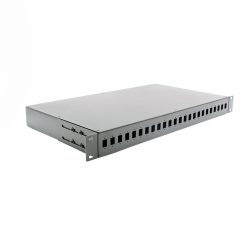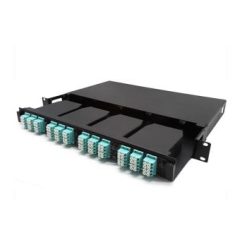
What is a Fiber Optic Patch Panel Optical Distribution Frame (ODF)?
A fiber optic patch panel Optical Distribution Frame (ODF) is commonly described as the interface panel that connects multiple optical fiber cables and optical equipment. Patch panels are rack-mountable onto 19”, 21”and 23” rack systems, and some are designed to be wall-mountable.
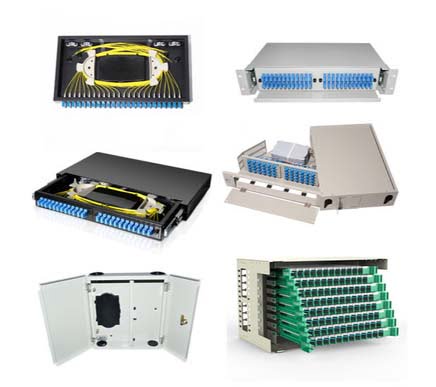
In physical terms, it is usually a metal enclosure that houses adapter panels, fiber splicing trays and space for excess fiber storage. Its basic construction consists of an array of ports where each port interfaces with another patch cable which is connected with optical equipment located elsewhere in the building. The adaptor panel provides an interface for both outside and inside ports to the enclosure. The inside ports are fixed as the cables are not meant to be disconnected at any point, whereas the outside ports are for fiber patching cables that can be plugged and unplugged for connections as required.
The splicing trays are neatly embedded in the enclosure to provide fusion with fiber optics pigtails which in turn plug into the fixed inside adapter ports of the adapter panel.
The benefits of using a fiber patch panel
- Facilitates the easy termination of fiber optic cables
- Well-organized and easy-to-manage connections of all the input jacks/ports into a patch panel in a central location
- Provides an easier means to connect different devices in different orders as all of the changes can be made at the patch panel
- Avoids cost incurred through wear and tear on the input ports of networking equipment as all the connections are patched using the ports in the patch panels
Common patch panel specifications
- Indoor or outdoor
- Rack-mountable or wall-mountable
- Front access only or both front and rear access
- Direct patching only or splice and patch
- Unloaded as a bare chassis, loaded with adapters only or loaded with adapters and pigtails
- Fixed, sliding or pivoting
- Intended application; single fiber, standard ribbon or SpiderWeb Ribbon® (SWR) cable
- Fiber count
- Rack unit height
- Type of adapter required
A versatile and comprehensive range of fixed, sliding and pivoting patch panels are available to support a variety of applications, installations and capacities.
- Stackable, individually rack-mountable or wall-mountable options
- 1U, 2U, 3U, 4U, 6U & 9U and many more rack unit height options
- Patch & Splice, Splice only & Patch only options
- All popular connector styles supported
- Comprehensive range of capacities and footprints
- LGX-compatible options
- Compatible with pre-terminated cables
- Comprehensive installation guides provided
- Installation accessories provided and additional accessories available for purchase