
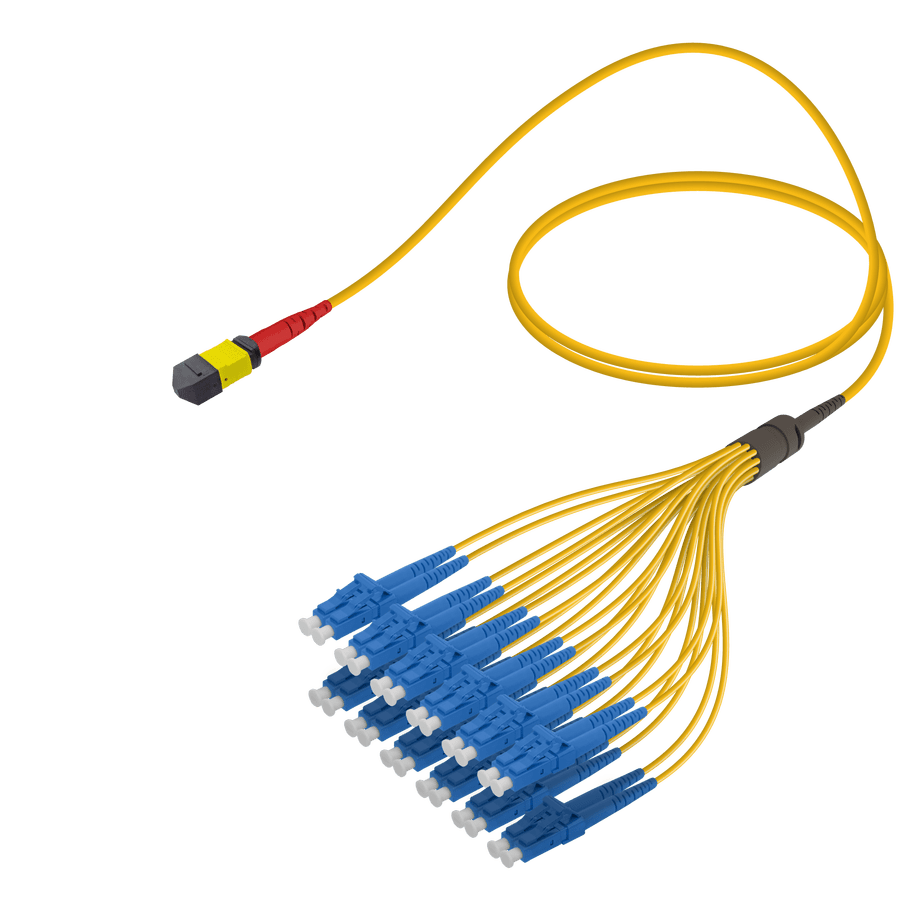
Male MTP® Elite to LC/UPC Fanout | Base-24 | Single Mode G657.A2 | 3.0/1.8mm
$28.30
Directly connect high-density equipment ports to individual devices with this male MTP® to LC breakout cable. This 24 fiber OM3 fanout cable features a low-loss MTP® Elite connector, ideal for splitting a single Base-24 port into 24 separate 10G/25G links over reliable OM3 fiber.
Overview
The Male MTP® to LC Breakout Cable provides a direct, high-density connection from network equipment to individual fiber links. This assembly features a single 24-fiber Male MTP® Elite connector (with pins) on one end, which fans out to 24 separate simplex LC UPC connectors. It is purpose-built to plug directly into MPO/MTP® ports on switches, servers, or transceivers, converting a Base-24 interface into 24 distinct channels.
Constructed with high-performance OM3 multi-mode fiber and a genuine MTP® Elite connector, this 24 fiber fanout cable guarantees the performance needed for reliable 10G, 25G, and 40G networking. By aggregating multiple connections into a single, streamlined assembly, it significantly reduces cable congestion and simplifies port mapping. This makes it an essential component for deploying scalable, high-density structured cabling in modern data centers.
Key Features
- Direct Equipment Connection: Features a Male MTP® connector with pins for plugging directly into device ports.
- High-Density Interface: Converts one 24-fiber MTP® port into 24 simplex LC connections for maximum port utilization.
- Elite Low Loss Performance: Equipped with a genuine MTP® Elite connector for minimal insertion loss, preserving link budget.
- Cost-Effective OM3 Fiber: Built with laser-optimized OM3 multi-mode fiber, supporting 10/25/40G data rates for standard data center distances.
- Simplified Cable Management: A single assembly replaces 24 individual patch cords, improving airflow and reducing installation time.
- Factory Tested & Certified: 100% inspected for low-loss performance, ensuring out-of-the-box reliability.
Applications
This breakout cable is ideal for connecting directly to high-density network hardware. A primary use case is plugging the male MTP® connector into a QSFP+ or QSFP28 port on a switch that is operating in breakout mode. The 24 LC connectors can then be patched to individual 10G or 25G SFP+ ports on servers or other network devices. It effectively bridges the gap between high-density switch ports and standard LC-based equipment interfaces.
Specifications
| Parameter | Value |
|---|---|
| Product Name | 24 Fiber Male MTP® to LC Fanout Cable |
| Connector A | MTP® Elite (Male, 24-Fiber) |
| Connector B | 24x LC UPC Simplex |
| Fiber Mode | Multi-Mode OM3 (50/125µm) |
| Fiber Count | 24 Fibers |
| Insertion Loss (MTP®) | ≤0.35dB (Elite Low Loss) |
| Insertion Loss (LC) | ≤0.20dB |
| Return Loss | ≥20dB |
| Main Cable Diameter | 3.0mm |
| Fanout Leg Diameter | 1.8mm |
| Jacket Material | LSZH (Low Smoke Zero Halogen) / OFNP (Plenum) |
| Jacket Color | Aqua (OM3) |
| Polarity | Customizable for various network schemes |
Cross-Platform Compatibility
This MTP® to LC breakout cable is manufactured in strict accordance with TIA/EIA and IEC industry standards for fiber optic connectors and cabling. Its standards-compliant design guarantees universal compatibility with any networking hardware or passive infrastructure that utilizes MTP®-24 and LC UPC interfaces. It integrates seamlessly with equipment from all major manufacturers, including:
- Cisco
- Juniper
- Arista
- HPE/Aruba
- Brocade
- Dell/Force10
- Finisar
- Intel
Advantages
The main advantage of using a male MTP® fanout cable is the ability to establish direct connections to active equipment without intermediate patch panels or adapters. This plug-and-play approach simplifies network design, reduces potential points of failure, and accelerates deployment. The use of OM3 fiber offers a cost-effective solution for achieving high data rates over the distances typically found within a data center or single building.
Furthermore, this pre-terminated assembly provides superior performance compared to field-terminated solutions. The factory-polished MTP® Elite connector ensures a stable, low-loss connection that protects signal integrity. This reliability is crucial for minimizing bit errors and maintaining uptime in business-critical network environments.
FAQ (Technical & Product Questions)
1. When should I choose a Male MTP® connector?
A male MTP® connector (with pins) is required when plugging directly into a female MPO/MTP® port, which is standard on most transceivers (like QSFP+), active equipment, and adapter panels. The male pins complete the connection by mating with the guide holes in the female receptacle.
2. What is the difference between OM3 and OM4 fiber?
Both are high-bandwidth multi-mode fibers, but OM4 offers a longer reach. For example, for a 40G/100G connection, OM3 supports distances up to 100 meters, while OM4 can support up to 150 meters. OM3 is a highly effective and cost-efficient choice for standard links within a data center.
3. What makes the MTP® Elite connector superior?
MTP® Elite connectors are a premium grade of MPO connector manufactured by US Conec to tighter tolerances. This precision results in significantly lower insertion loss (IL ≤ 0.35dB), ensuring better signal strength and link performance compared to standard MPO connectors (IL ≤ 0.75dB).
4. What does “Base-24” mean for this fanout cable?
Base-24 indicates that the MTP® connector contains 24 individual fibers, typically arranged in two rows of 12. This fanout cable is designed to utilize all 24 fibers, breaking them out into 24 individual LC connections for maximum density and throughput from a single port.
5. Can this cable support 40G or 100G speeds?
Yes, while it fans out to individual LC connectors often used for 10G/25G, the underlying Base-24 MTP® interface is central to parallel optics for 40G and 100G. This cable is often used at one end of a link to break out channels from a high-speed parallel optic transceiver (e.g., SR4, SR8, or SR10).
6. Why use a fanout cable instead of 24 individual patch cords?
A fanout cable consolidates 24 fibers into a single, robust assembly. This drastically reduces cable bulk and clutter in racks and pathways, improving airflow and making cable management significantly easier. It also simplifies the process of connecting high-density ports.
7. What is the difference between MPO and MTP®?
MPO (Multi-fiber Push-On) is the generic industry standard for this type of connector. MTP® is a specific, high-performance brand of MPO connector with patented enhancements by US Conec, such as a floating ferrule and elliptical guide pins, which provide better mechanical stability and optical performance.
8. What is the benefit of the UPC polish on the LC connectors?
UPC (Ultra Physical Contact) is a high-grade polish applied to the connector’s fiber tip. It creates a slightly curved surface that ensures optimal core-to-core contact when mated. This minimizes back reflection and reduces insertion loss, resulting in a more stable and reliable signal.

Bulah –
Seamless integration with existing network infrastructure using these MPO/MTP patch cords.
Otto –
Great compatibility with different network devices using these MPO/MTP patch cords.
Adriana –
Consistent and reliable data transfer with these MPO/MTP patch cords.