
When choosing fiber optic cables or fiber connectors, you may find that the description of the product noted the word “PC Polish”, “UPC Polish” or “APC Polish”. What do these words mean? What’s the difference between these connector types? This post will shed light on these connector types and their differences for you.
Introduction to Different Connector Types
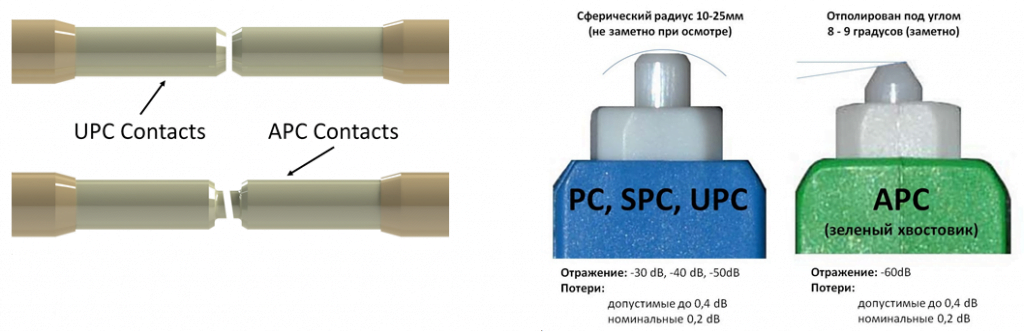
To put it simply, PC, UPC, and APC refer to the polish styles of the ferrules inside the fiber optic connectors, just as the following figure shows. The ferrule is the housing for the exposed end of a fiber, designed to be connected to another fiber, or into a transmitter or receiver. When connectors are installed on the end of a fiber, light is reflected back up the fiber towards the source, disrupting the signal. To increase the efficiency of fiber, engineers began to upgrade the surface of the critical point of attachment, and that’s how ferrule polish technologies are introduced. There are four connector polish types, three of which will be highlighted below.

Figure 1: Ferrule polish
PC Fiber Connector
PC fiber connector refers to the connector that is polished in the physical contact style. It is the most common polish type that is found on OM1 and OM2 multimode fiber. PC fiber connector was generated to overcome the air gap between two surfaces from small imperfections in the original flat fiber connector. In PC fiber connector design, there is a slightly cylindrical cone head with the aiming to eliminate the air gap, so that the typical return loss in single mode applications is about -40dB, higher than the return loss of the original flat polish style (-14 dB or roughly 4%). Up to now, this polish style has been outdated and the evolution – UPC polish style has come into being.
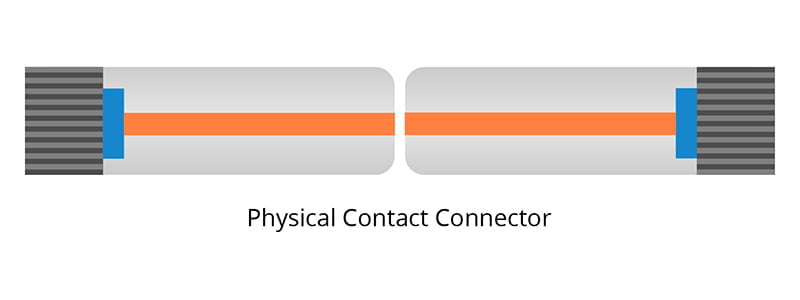
Figure 2: PC fiber connector
UPC Fiber Connector
UPC is the acronym for Ultra Physical Contact. It is an improvement of the PC fiber connector with a better surface finish after an extended polishing and the return loss is better than PC structure, nearly -50dB or higher. Though it has a relatively lower back reflection in comparison with the PC connector, it is not robust enough. Note that repeated connections and disconnections will bring about the degradation of the surface and ultimate performance.
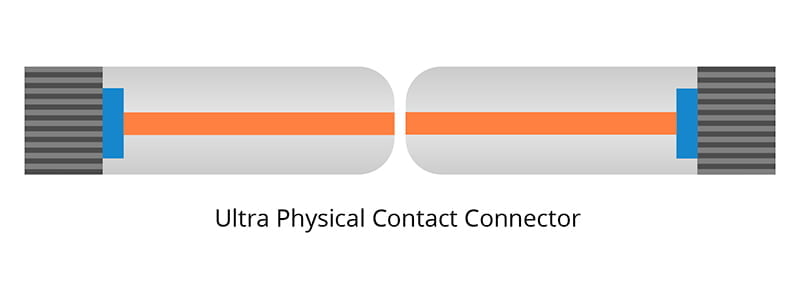 Figure 3: UPC fiber connector
APC Fiber Connector
Out of the pursuit of lower back reflection, APC fiber connectors were developed. APC refers to Angled Physical Connect, the ferrule endface radius of which is polished at an 8°angel, minimizing the back reflection as a result. Since adding the angled endface, the reflected light will leak out into the cladding instead of staying in the fiber core. It should be noted that APC connectors should only be mated with other angled-polished connectors rather than non-angled polished connectors, or it will cause very high insertion loss. The optical return loss of APC connectors is -60dB or higher, better than the other connector types.
 Figure 4: APC fiber Connector
PC vs. UPC vs. APC: What Are Their Differences?
After the definition of three connector types, you will find that PC, UPC, and APC connectors vary in many aspects. The following lists their differences in appearance, performance, and application categories.
Appearance
The major difference in terms of appearance is the fiber endface. PC connectors and UPC connectors are both polished with no angle, though endface of UPC has a slight curvature. Instead, an APC connector is featured with 8° angle endface.
Another obvious difference is the color. It is visible to distinguish which type of polish style the connector features by the color of the connector body. Take an LC APC single mode fiber optic patch cable as an example, the connectors on both fiber ends are all green. While for an LC UPC single mode fiber optic patch cable, the connectors are generally blue. It is also a simple way to tell these connectors apart.
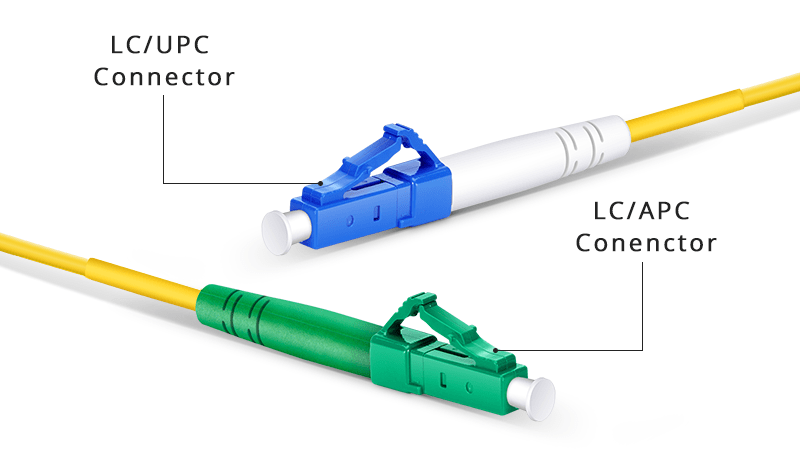 Figure 5: LC/UPC VS LC/APC
Performance
It used to be hard to achieve low insertion loss using APC connectors owing to the air gap in the apex offsets, yet nowadays the improvement of connector design and manufacturing push APC connectors to perform better. The insertion difference between APC and UPC has been diminished.
As for the performance of return loss, you may have noticed APC connectors have the lowest back reflection of all the fiber connectors mentioned owing to the angled endface. For this reason, the values of the return loss are different. According to the industry standards, the return loss of PC, UPC, and APC connectors is respectively about -40dB, -50dB, and -60dB or higher. The higher the return loss is, the lower the reflection and the better the connector performance will be. It proves that APC connectors are higher-performing among the connectors listed.
Application
Since some applications are more sensitive to return loss, APC connectors are preferred in these fields, for instance, in higher wavelength range like those used for RF video signals, especially FTTx applications and for applications such as passive optical networks and other WDM systems using high wavelength via single mode fiber.
For those applications where return loss is not paid much attention to, UPC or PC comes into play. PC connectors are generally seen in telecom operators’ equipment, while UPC connectors are popular in digital TV, telephony and data systems.
APC connector usually has a green body with an end-face still curved but are angled at an industry-standard 8 degrees (showed in the above picture) which allows for even tight connections and smaller end-face radii. Thus any light that is redirected back towards the source is actually reflected out into the fiber cladding, again by virtue of the 8 degree angled end-face. APC ferrules offer return losses of -65dB. Some applications are more sensitive to return loss than others that call for APC connectors, like FTTx and Radio Frequency (RF) applications. APC connectors are also commonly used in passive optical applications due to the fact that many of these systems also use RF signals to deliver video.
PC, UPC or APC connector, which should be the choice of fiber optic connector? The answer is it depends. Choosing the appropriate connector for a fiber network depends on things such as, network design and function.
Conclusion
It is improper to say whether PC, UPC or APC is the best polish type of fiber connectors. When choosing fiber connectors for specific applications, factors such as cost and operability should be considered. However, there is one rule that should be followed: for those applications which high precision optical fiber signaling matters, choose APC; for less sensitive digital systems, PC or UPC is capable.


