
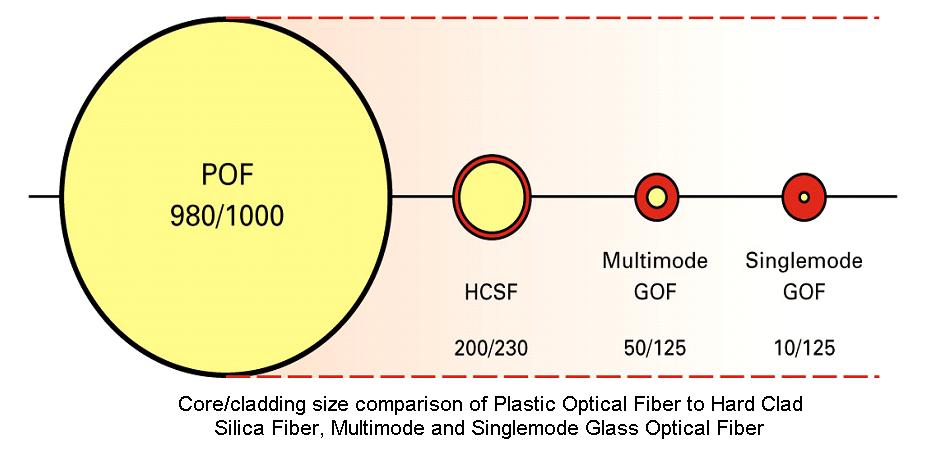
Plastic optical fiber, or POF, has been overshadowed in the last decade by the success of glass optical fiber. As a result, POF had been relegated to low bit rate and short distance applications. Recent technological advances and the emergence of a killer application in the automotive industry have propelled POF into the limelight of a lower cost alternative to glass fiber or copper at medium distances and bit rates of 10 gbps. This paper reviews the history of POF , the technical developments that have created a buzz about POF, and the applications which are propelling POF into the mainstream. In addition, POF technology exhibits similar properties attributed to “Disruptive technologies”.
When people hear of optical fibers, they immediately think of glass. Few people, including professionals in the business, know about plastic optical fibers (POFs), which predate those made of glass. Because glass fibers have certain advantages, they have dominated the market, while POFs have remained largely in the background. Recent developments in technology and applications, however, have burnished the image of POFs, and they are finding a larger market with technology companies worldwide. Today, a new enthusiasm permeates the plastics side of optical fibers. The paper reviews the development if plastic optical fibers, emerging applications, and technological developments.
POFs compete with copper wires, coaxial cables, glass optical fibers, and wireless, and they require a transmitter, receiver, cables, and connectors similar to those used in glass optical-fiber links. Manufacturers form POFs out of plastic materials such as polystyrene, polycarbonates, and polymethyl methacrylate (PMMA). These materials have transmission windows in the visible range (520-780 nm).
However, the loss of light transmitted at these wavelengths is high, ranging from 150 dB/km for PMMA to 1,000 dB/km for polystyrene and polycarbonates. These losses often handicap plastic fibers in competing against high-quality glass fibers, which have losses of 0.2 dB/km for a single-mode fiber and less than 3 dB/km for multimode fibers. Hence, plastic fibers have been relegated to short-distance applications, typically of a few hundred meters or less, compared with the hundreds of kilometers for glass. Nonetheless, POFs have found many applications in areas such as industrial controls, automobiles, sensors for detecting high-energy particles, signs, illumination (including lighting works of art in museums), and short data links. Basically, POF applications divide into data-communication and non-data applications (sensors and signs, for example). Today, the surge in POF production stems from its use in data transmission.
What are the advantages of POF? Certain users find POF systems provide benefits compared to glass fiber or copper wire, which include:
• simpler and less expensive components
• lighter weight
• operation in the visible
• greater flexibility, and resiliency to bending, shock and vibration
• immunity to electromagnetic interference (EMI)
• ease in handling and connecting
• use of simple and inexpensive test equipment
• greater safety than glass fibers or fiber slivers that require a laser light source
• transceivers require less power than copper transceivers
Mefiber is a fiber optic cable supplier from which you can custom plastic optical fiber that fits your needs. It provides both simplex and duplex plastic optical fibers. The standard color is black, and other colors are available upon request.