
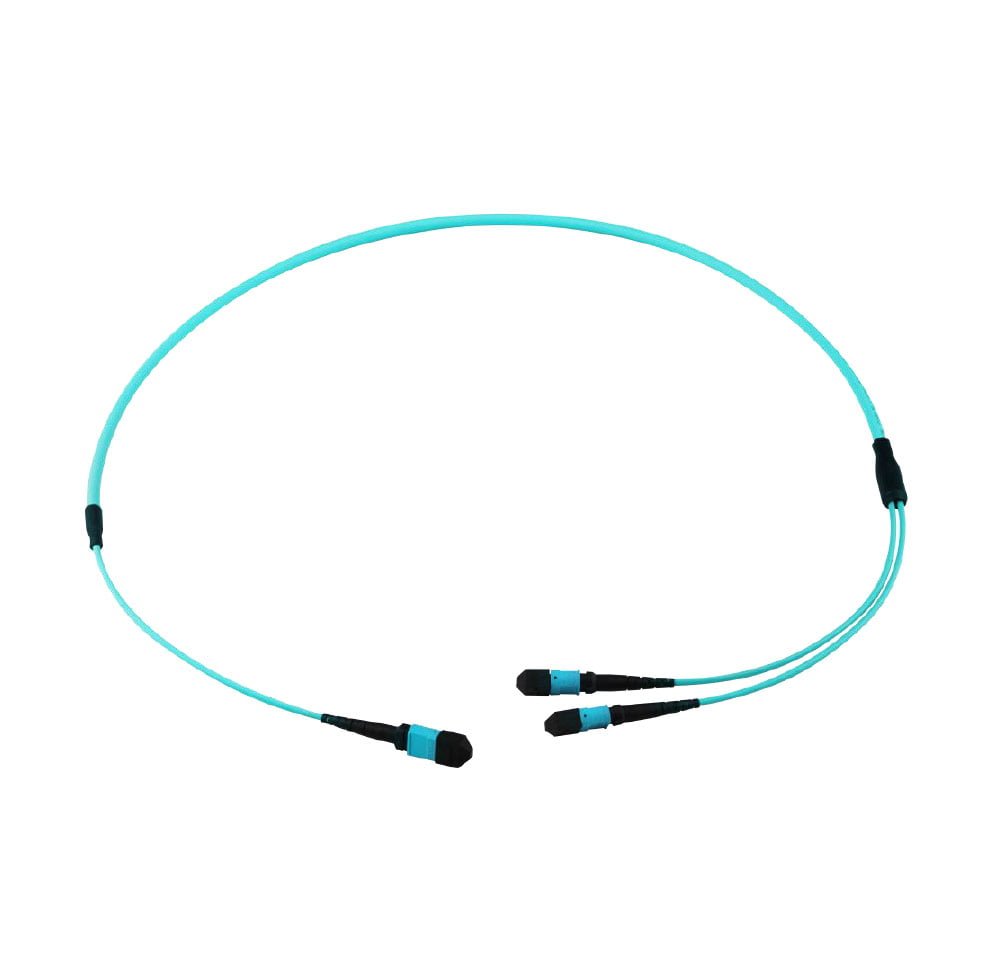
24 core MPO/MTP Trunk Fiber Optic Cable
24 core MPO/MTP Trunk Fiber Optic Cable MPO/MTP ribbon and trunk mulitcore cable assemblies facilitate rapid deployment of high density backbone cabling in data centers and other high fiber environment, reducing network in stallation or reconfiguration time and cost.MTP/MPO are used to interconnect cassettes, panels, or fan outs, it offered in fiber typs in standard 8 , 12 ,24 ,or 48 cores versions using a compact and rugged microcables structre. The compact cable optimize cableway use and improve airflow.These MPO/MTP cable are build with the highest quality components , Low loss elite versions are offered, featuring low insertion loww for demanding high speed networks where power budgets are critical.
Application
- Data communication network.
- Optical System Access network.
- Storage area networking fiber channel.
- High density architectures.
Features
- 100% pre-terminated and tested in factory to ensure transfer performance.
- Rapid configuration and networking, reduce installation time.
- Supports 40G and 100G network
- Cable Jacket material: LSZH, OFNR, OFNP
- Supports up to 12F, 24F, 48F, 72F, 96F, 144F, customized products are
Connector Types
| Type | Reference | Note | |
|
MPO |
IEC 61754-7 |
Single mode |
APC: Green connectors (Standard ) APC: Yellow connectors (Elite) |
| Multimode | PC: Aqua Connectors | ||
|
MTP |
IEC 61754-7 |
Single mode | APC: Green connectors (Standard ) APC: Yellow connectors (Elite) |
| Multimode | PC: Aqua Connectors | ||
Dimensional Diagrams
- MPO/MTP Trunk Cable (Method A, Method B, Method C).
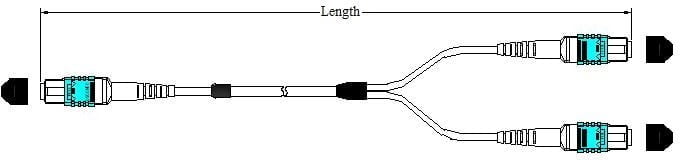
Patch
| Jumper tolerance requirement | |
| Overall length (L) (M) | length of tolerance(CM) |
| 0<L≤20 | +10/-0 |
| 20<L≤40 | +15/-0 |
| L>40 | +0.5%L/-0 |
Cable Structure 24 core MPO/MTP Trunk Fiber Optic Cable
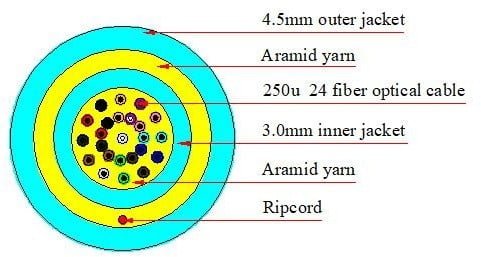
Cable Parameters
|
Cable Count |
Out sheath Diameter (MM) |
Weight (KG) |
Minimum allowable Tensile Strength (N) | minimum allowable Crush Load
(N/100mm) |
Minimum Bending Radius (MM) |
Storage temperature (℃) |
|||
| short term | long term | short term | long term | short term | long term | ||||
| 24 | 4.5±0.2 | 32 | 560 | 250 | 750 | 300 | 20D | 10D | -20 ~~ +70 |
Optical Characteristics
|
Item |
Parameter |
Reference |
|||
| Single mode | Multimode | ||||
| Standard | Elite | Standard | Elite | ||
|
Insertion loss |
Typical≤0.30dB Max≤0.75dB | Typical≤0.15dB Max≤0.35dB | Typical≤0.50dB Max≤0.25dB | Typical≤0.10dB Max≤0.35dB |
IEC 61300-3-34 |
| Return loss | ≥ 50dB (PC)
≥ 60dB (APC) |
≥ 55dB (PC)
≥ 65dB (APC) |
≥30dB(PC) | ≥30dB(PC) | IEC 61300-3-6 |
End-Face Geometry
|
Ferrule parameter |
IEC-61300–3-30 | |||
| Minimum | Maximum | |||
|
ROC |
ROC-X: | 2000mm | ∞ | |
| ROC-Y: | 50mm | ∞ | ||
|
Angle |
Angle-X: | -0.2° | 0.2° | |
|
Angle-Y: |
PC | -0.2° | 0.2° | |
| APC | 7.85° | 8.15° | ||
| Fiber Hight: | 1000nm | 3500nm | ||
| Max.DH.All: | -300nm | 300nm | ||
| DH.Adj: | -300nm | 300nm | ||
| DH.Ave Fiber: | -300nm | 300nm | ||
|
Core Dip: |
MM | -200nm | 300nm | |
| SM | N/A | N/A | ||
| Ferrule height | 7.9mm | 8.05mm | ||
End-Face Qualty (SM)
| Zone | Range (μm) | Scratches | Defects | Reference |
| A: Core | 0 to 25 | None | None |
IEC 61300-3-35:2015 |
| B: Cladding | 25 to 115 | None | None | |
| C: Adhesive | 115 to 135 | None | None | |
| D: Contact | 135 to 250 | None | None | |
| E: Rest of ferrule | None | None | ||
End-Face Qualty (MM)
| Zone | Range (μm) | Scratches | Defects | Reference |
| A: Core | 0 to 65 | None | None |
IEC 61300-3-35:2015 |
| B: Cladding | 65 to 115 | None | None | |
| C: Adhesive | 115 to 135 | None | None | |
| D: Contact | 135 to 250 | None | None | |
| E: Rest of ferrule | None | None | ||
Mechanical Characteristics
| Test | Conditions | Reference |
| Endurance | 500 matings | IEC 61300-2-2 |
| Vibration | Frequency: 10 to 55Hz, Amplitude: 0.75mm | IEC 61300-2-1 |
| Cable retention | 400N (main cable); 50N (connector part) | IEC 61300-2-4 |
| Strength of coupling mechanism | 80N for 2 to 3mm cable | IEC 61300-2-6 |
| Cable torsion | 15N for 2 to 3mm cable | IEC 61300-2-5 |
| Fall | 10 drops, 1m drop height | IEC 61300-2-12 |
| Static lateral load | 1N for 1h (main cable); 0.2N for 5min (ranch part) | IEC 61300-2-42 |
| Cold | -25°C, 96h duration | IEC 61300-2-17 |
| Dry heat | +70°C, 96h duration | IEC 61300-2-18 |
| Change of temperature | -25°C to +70°C, 12 cycles | IEC 61300-2-22 |
| Humidity | +40°C at 93%, 96h duration | IEC 61300-2-19 |


